Showing posts with label Uterine Cancer. Show all posts
Showing posts with label Uterine Cancer. Show all posts
Uterus is part of a woman's reproductive system. It is a hollow, pear-shaped organ that a baby grows. The location is near to pelvis between the bladder and rectum.
The tight and the cervix are exactly located under the uterus. The wide, middle part of the uterus is the body, or it’s also called corpus.
Commonly in women of childbearing age, lining of the uterus grow and thicken each month to prepare for pregnancy. If a woman is not pregnant, the thick, bloody lining flows out of the body through the vagina. This condition we often called it menstruation.
 Uterine Cancer
You have to remember that benign tumors are not cancer. Most doctors can help you to remove it. The benign tumors cells do not spread to other parts of the body. In many cases, the benign tumors do not return after its removal. Most essential, benign tumors are not often a threat to life.
But, some research also report that malignant tumors are cancer. They are commonly more serious and life threatening. Cancer cells can penetrate and damage nearby tissues and the organs. Cancer cells also can break with a malignant tumor and enter the blood or lymphatic system disorders. That is how cancer cells spread from the original (primary) tumor to form new tumors in other organs. And that condition often called as metastasis.
 Uterus cancer
When uterine cancer extends (metastasizes) outside the uterus, cancer cells often found in nearby lymph nodes, nerves and blood vessels. If the cancer cell has reached the lymph nodes, then cancer cells has the ability to spread to other lymph nodes and into other organs like lungs, the worse is come to liver and bones.
 Endometrium-Uterus
When the cancer cell spreads from its original place to another part of the body, the new tumor has the same type of abnormal cells and the same name as the primary tumor. For illustration, if the cell cancer of the uterus spreads to the lungs, the cancer cells in the lungs are actually uterine cancer cells. The disease is metastatic uterine cancer; please note that is not lung cancer. It is treated as cervical cancer, not lung cancer. Doctors sometimes named the new tumor "distant" disease.
Generally the uterus cancers are usually started from the lining (endometrium). This condition called endometrial cancer, uterine cancer and cancer of the uterus.
Cervical cancer is a deadly cancer, which actually begins in the feed cells in the uterus. The breast or the uterus is an important part of the reproductive organs in women.
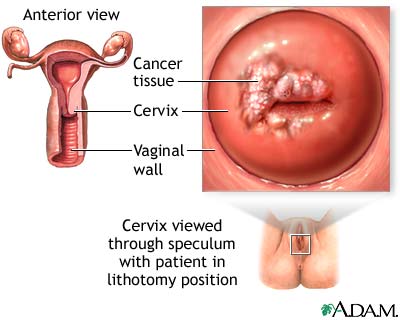 Cervical cancer
Type of uterine cancer
To cancer in May indicate several types of cancer, occurring in a woman's uterus. Uterus sarcoma, commonly known as leiomyosarcomas is a type of uterine cancer, which occurs in muscle energy layer of the uterus. An endometrial cancer is another type of uterine cancer, derived from the cells located in glands in the uterine lining, or endometrium. Cervical cancer is another type of uterine cancer, which is known to occur from the bottom of the uterus. It extends to the transition of a woman in the cervix and the link to the top of her vagina.
 Cervical cancer pictures
SYMPTOMS
A woman who had cervical cancer may notice a few common symptoms. They can vary from person to person depending on the disease in question. Commons symptoms include painful or difficult urination, unusual vaginal discharge or bleeding, extreme pain during the time of having a sexual relationship, a typical lap level lump, abnormal weight loss, pain in the pelvic region and have never breast. The fact is that cervical cancer rarely occurs before menopause, when a woman has regular menstrual periods.
Usually occurs during a regular menstrual cycle stops. If a woman notices back of bleeding at this stage of his life must immediately come to his general doctor, as there may be a risk of uterine cancer.
The well known symptom of uterine cancer is abnormal bleeding from the uterus of a woman after menopause. Bleeding may be in the form of a strip of blood, waste water contains more blood. In some cases a woman may experience lower abdominal pain also.
CAUSE
There are several reasons for cervical cancer, which have been detected so far. Diabetes, obesity, polycystic ovaries have prolonged anovulation, nulliparity or relatives, not a single child, lack of menstruation, prolonged use of tamoxifen for the treatment of breast cancer and are taking estrogen unanimously without progestins are no valid reasons for uterine cancer.
 Cervical cancer
The diagnosis of this disease
Cancer can be diagnosed by endometrial and endocervical sampling. In addition to these techniques, vaginal ultrasound is used to detect the thickness of endometrium greater thickness, as the uterus, can cause serious cancerous change. In addition to the Pap test can also be an exact identification of cervical cancer, but cannot be defined as a reliable source.
Treatment
The treatment of this cancer is based on the quality and stage of cancer. Abdominal hysterectomy is a standard treatment, which involves surgical removal of the female uterus with both ovaries and tubes, washing of the abdominal cavity to determine the malignant cells and selectively remove Aortic and pelvic lymph nodes. Many doctors prefer the use of hormonal therapy, which eliminates the risk of metastatic cancer. Again, the women also choose radiotherapy to treat their cervical cancer.
Although the treatment of uterine cancer is possible to do, but you should takes immediate action after notice symptoms. Do not let it reach a level which cannot be cured!
-- Article source : http://www.womenscenter.com/ ---
Subscribe to:
Posts (Atom)


